Blog Feed

Power Imbalances

I want to state that I am unapologetically pro law enforcement.  I have close friends in the law enforcement world who are serve at a federal level as well as at the local level.  I have multiple family members who have served as military police, and I have a son who plans to enroll into the law enforcement academy.  As I previously stated I am unapologetically pro law enforcement.  I believe there are wonderful men and woman who serve and protect our communities every day and I am thankful for each and every one of them. 

These positions of authority that call upon men and woman of the job to carry a badge, cuffs, and a gun are not without limits.  They cannot operate with impunity.  Those who serve well understand this.   They know that they possess power.  In fact, all who are leaders and have authority live in the dichotomy of a power imbalance.  Power imbalances in and of themselves are not wrong.  Teacher and students are another example of a power imbalance.  A principal and a teacher is another.  They exist.  It isn’t wrong that they do.  However, power imbalance without limit is tyranny.  We know this and we believe this.  We have seen it in nearly every segment of society.  Clergy who abuses his flock in any manner is guilty of this.

My credentials as a clergy do not give me permission to abuse those in my care.  A teacher’s credentials do not give them permission to abuse those in their care.  The same is true of law enforcement.  More power means there must be more self-control.  More power means there must be more self-awareness.  More power means there must be more accountability.  It does not matter what you are armed with is you live in a power imbalance: words, grade books, or guns, you have a higher standard to follow.  The professions that I listed, clergy, teachers, law enforcement, all must adhere to a higher standard.  For these jobs are more than jobs.  They are callings of service, entrusted by communities to those who possess the power for the betterment of the community.  These jobs are not for those who fill the positions but rather for those that are served.  They are high callings.

James 3.1 says, “Let not many of you become teachers, my brethren, knowing that as such we will incur a stricter judgement.”  It is my belief that the author of this epistle is specifically speaking to those who would teach in the church.  These teachers could do great good but also have opportunity to do great harm.  Those who inflict harm will answer for it.  If you are granted a position of authority, you better make sure you get it right.  I believe we can apply this truth to all who live in the power imbalance.  

In the Spiderman movie there is a scene where Uncle Ben is dropping off Peter (Spiderman) after giving him a ride.  In short conversation with Peter Uncle Ben drops the following truths that are still true of all of us.

“These are the years a man changes into the man he is going to become for the rest of his life.  Just be careful who you change into.”

We do not get to hand out injustices and blame anyone but ourselves.  Proper training and sometimes proper therapy are a must.  I have a number of men in my life that I know I can call when I feel the heat on me.  I even have a therapist for when times get really hard.  If I mess up, lots of people get hurt.  I must pursue health.  I possess influence and therefore I also possess responsibility to change properly. There is no one to blame but me when my actions and words harm those entrusted to my care.

“Just because can beat him up doesn’t give you the right to.”

Many times, as a parent my wife and I have said to our kids, “Just because you can, doesn’t mean you should.”  I don’t remember getting this from Ben Parker, but it is a truth that we live by in our home.   These words also echo of the truths found in the sermon on the mount where Jesus said, “You have heard it said…but I say…”  He was saying that the way of the Christ follower is not the same way as cultural norms.  Cultural norms serve as protectors and permission givers but often protect those who would protect wrongdoing and give permission to awful things.  The Jim Crow laws were legal but hardly were they right.  Redlining was policy but it was hardly just.  Just because you can, doesn’t mean you should.

“Remember, with great power comes great responsibility.

The beauty of living in a power imbalance is that you are given an opportunity to bless people.  You get to add value to their lives.  You get to offer security and safety.  You get to provide for needs that would have gone unmet.  You get to restore dignity.  Sadly, not all choose to do this.  And they will incur a stricter judgement.  

Power

A wise man once  said, “You cannot serve two masters” (Matthew 6.24). The man who said this: Jesus Christ.  Ultimately the downfall of the nation of Israel in the Old Testament was rooted in this reality.  They desired God and ________.  

When God becomes not enough for His children they do what the nation of Israel did.  They make an idol (Exodus 32).  They desire a new king (1 Samuel 8).  Some days they even say, “God you aren’t enough”, but not always with their words but often with their actions.  They replace pursuit of holiness with pursuit of influence. After all, why wouldn’t they.  “Did God really say” (Genesis 3.1) becomes a question used to justify this.  Yet no-one seems to pause long enough to recognize that this statement was authored by the father of lies (John 8.44).

When power becomes the pursuit of those who call themselves followers of the All Powerful One, it declares to those who watch, God is not enough.  One simply cannot live by faith and pursuit of power.  “A house divided against itself will not stand” (Mark 3.25).

Satan once said to Jesus, “bow down to me and I will give you all the kingdoms of the earth” (Matthew 4.9).  Jesus replied with, “Away from me, Satan!  For it is written: ‘Worship the Lord your God, and serve Him only’” (Mathew 4.10)  Today Satan is saying to the followers of Jesus, “I have something for you but you too must compromise your allegiance.  Don’t worry, the end justifies the means.”  My prayer is that believers will give the same response that Jesus did, “Get behind me Satan!  I only worship the one true God!  I only serve the one true God!”

In conclusion, “what good is it, if a man gains the whole world, yet loses his own soul?” (Matthew 16.26)

Fruit>Power – Jesus said it.

Jesus did not desire to overturn Roman rule.  He desired to overthrow the throne of your heart.  The overthrow of the throne of your heart would then lead to a radical transformation of your life.  His Kingship, though internal, would manifest itself outwardly.  The fruit of this would then be seen, heard, and felt.  Love, joy, peace, patience, kindness, goodness, faithfulness, gentleness, self-control would all be present.  At the same time outbursts of anger and an argumentative spirit would be among things that would no longer be present because the fruit that was produced would eventually choke out these poisons.  

In world where it still appears as though Rome is ruling, does it appear to those who are watching you that Jesus is ruling you?  

There were attempts made to take Jesus and make Him king.  Whenever His followers pursued influence over holiness Jesus always countered with correction.  Domination and power over are never the goals of the kingdom of God.  It is power under.  As we live a life under the influence of our King and we allow His influence to permeate every facet of life and flow forth in such a way that the aforementioned fruit becomes available and accessible to all who come in contact with us.  

If you spend all your time guarding your garden, your vegetables will eventually get choked out by weeds. True, birds, rabbits and rodents might never eat your fruit but guess what?  If you spend all your time tending your garden, weeding it, watering it, pruning it, you will also not have the birds, rabbits, and rodents eating your crop?  Why?  Because you are also present.  Yet at the same time, you will produce way more fruit.  Simply put, if your whole life is spent watching for evils to fight versus cultivating the good around you that you can control, your fruit production will always suffer.  At the same time those around you will suffer because God in His providence has called you to produce His fruit and give it away to those He has put in your path.  

Brokenness>anger, fear, and judgment

Jonas Salk is quoted with “Hope lies in dreams, in imagination, and in the courage of those who dare to make dreams into reality.”  When I read this quote, I can’t help but ask the question: where has the hope gone.  

Years ago, I did a sermon series and through the series I included the following big idea: for, not against.  With the idea that the church world needed to be known more for what they were for than what they were against.  I fear that we are living in times when this is often not the case.  Sadly, much of the church world has taken their cues not from the Scriptures but rather they have taken their cues from culture and politics.  I fear that many Christian leaders may have replaced time in their studies with time spent with their favorite cable news commentor.  We must get back to the place where we, like John Wesley, strive to be known as men and women of one book and not men and women of one political persuasion.

I was born in 1979 and grew up in the height of the purity culture and culture wars.  Like many in that era who were from the more conservative persuasion, there was a time when I was a disciple of Dr. James Dobson and Rush Limbaugh.  When I was in my 20’s I tuned both of them out.  I distinctly remember the day that I was at work and had Rush Limbaugh playing in the garage bay that I was working in.  I was struck with the thought; all Rush did was make me angry.  I was not full of compassion as Jesus was when He surveyed Jerusalem and wept over those who never get it.  I was just mad because people were living like they would never get it.  

With Dr. Dobson it was different.  I have fond memories of things that came from his organization like “Adventures in Odessey” and the recommended book for my wife and I, “The Strong Willed Child.”  At the same time, when I think of Dr. Dobson, I have a much different perspective than many.  I know this will upset many but again please remember I am sharing my perspective that I gained as a youth.  It is one that I have carried with me since the 80’s when Christian’s began reading every label in the grocery store to make sure they were boycotting the proper company.  This stuck with me.  Dobson to me, even as a child, represented a voice that typically sounded kind but took every opportunity he could to point how the church was under attack.  During this time, his views were tied directly to politicians.  For many people of my generation, we grew up believing a politician, not Jesus, was the hope of America.  Some of you probably even had a friend or relative that had a picture of Ronald Reagan somewhere in their home and every two years you got a voting guide that was either mailed to your home or passed out in your church.  This voting guide told you exactly how to vote and somewhere in the process you were told, this is the most important election ever. 

In the mid to late 90’s there was a season where I attended a King James only Independent Fundamental Baptist Church.  Here, protecting the 1611 KJV Bible was seen as more important than protecting anything else.  Some refer to this not as King James only but King James ugly.  There was an ugliness that existed in this isolationist cult-like corner of Christendom.  I believe they truly love Jesus, and they truly will be in heaven someday but when they get there, they will be shocked to find that St. Peter isn’t going to be speaking the King’s English at the pearly gates.  They will be equally as shocked when they realize that the worship in heaven might include cymbals and won’t be a collection of their favorite hymns.  The most shocking of all is that they will encounter not just fundamental Baptists in heaven but will worship with people that they thought would never be there.  They would see Lutherans, Catholics, Methodists, Presbyterians, Charismatics, Wesleyans and others.  While my first question to Jesus might be, “can you introduce me to your mom,” they will be asking “why are all these reprobates in heaven?”  This may sound harsh but what I learned in this period of my life was that everyone was wrong and liberal but us.  

I no longer ask Rush Limbaugh, Dr. Dobson, or Independent Fundamental Baptists for their opinions when I seek to engage with the world around me.  I now ask Jesus.  I look to the character, actions, and words of my Savior.  Limbaugh made me angry, Dobson made me scared, and the Fundy’s made me judgmental.  Jesus provides another path.  I am now full of hope.  I am now more compassionate.  I am now more patient.  I am now more forgiving.  I am now more loving.  I hope that I am now more like Jesus.  

Above all, I am heartbroken. 

I routinely pray that I would resemble Jesus who went up on the mountain top that overlooked Jerusalem and wept.  Even though Jesus knew that the people in the city below would viciously murder Him, He wept over their spiritual condition and the future that awaited them.  He wanted better for them.  Ultimately, this broken heart, drove Him to walk back down that mountainside, walk back into Jerusalem, and walk to the cross where He would be crucified to pay for the sins of His executioners and others.  There He would declare, “Father, forgive them for they know not what they do.”

I find heartbreak is a much better place to live out my life than anger.  Heartbroken people tend to live lives determined to heal where anger when it sits long enough often only creates wounds and division.  Jesus, the Great Physician, offers healing where much of His church offers outrage.  He offers hope where those who claim to follow Him often offer judgement.  

Friends, let’s not forget, “we wrestle not against flesh and blood.”  When we do, our outrage is directed towards those that Jesus directs grace towards.  May we too weep over our cities.  May we too pray, “Father, forgive them for they know not what they do.”

When we fix our eyes on Jesus, we become men and women of hope.  Jesus did not just weep over the nation; He provided a solution and invited them into a right relationship with His Father.  He provided hope.  Restoration of humanity was no longer just a dream but a reality to be grasped.  This is found in Christ alone.  

Processing Yesterday’s Murder of Charlie Kirk

Yesterday afternoon as I waiting for children to get off a bus at my church, I received a text from a friend who informed me that Charlie Kirk had been shot while he was speaking at one of his events.  Shortly thereafter, two more friends began texting as well.  Two of them even sent videos which I watched.  I nearly threw up after watching the first video and concluded on my own that the shot had been fatal.  

As I sat there at my desk, I could hear children in our church.  They made squeals of joy, and I could hear the pitter patter of little footprints as they played games and enjoyed their friends.  As they innocently enjoyed life, I sat alone in my office wondering what in the world this world was coming to.  At the same time, I was thankful for their innocence and even a bit envious.

Once I processed things for a moment, I was struck with the thought, this doesn’t surprise me.  The violent and angry rhetoric that has invaded both sides of the aisle had led us to this point.  Some would argue that we have left our roots as a Christian nation.  Charlie Kirk was one of those who would argue this.  My concern is that many of my brothers and sisters are living in the pursuit of returning to a Christian nation and in turn have set aside their marching orders in order to get there.  The call is not to create a theocracy but an expanse of a kingdom that is already here: the kingdom of God.  Not a pursuit of power but a pursuit of holiness.  For the believer, our marching orders are not the Constitution and the Bill of Rights (although we are blessed to have these documents).  Our marching orders are found in the Sermon on the Mount.  They are found also in Matthew 22 which speaks of loving God and loving people.  

Why do I bring that up?  Well, the response to this shooting is to be expected.  The outcry is loud as it should be.  Kirk was an influential voice and most of the country witnessed his murder as they scrolled their phone through their social media feeds.  Also on our social media feeds are ugly responses.  We don’t really know what happened yet, but the blame game is already going full force.  As to who did it and what is their reason, we don’t know.  I have my suspicions as many do but I just really don’t know.  

Tragedy always reveals the heart of a nation and always reveals the heart of God’s people.  I am deeply saddened at what it has revealed.  Again, I am not shocked.  I am disappointed.  I am sad.  I am saddened that a 31 year man was senselessly murdered (probably because of ideology).  I am saddened that a young wife spent last night awake wrecked with grief.  I imagine she ventured into her sleeping children’s rooms and cried over them and wondered how she is going to raise them on her own.  Her little one’s woke up this morning and momma looked at them, she knew, life would never be the same.  I am saddened that there are Utah Valley University students whose lives will never be the same.  They witnessed a disgusting act of a violence that most of them cannot even process, but their minds have put the whole thing on repeat.  I am saddened that my social media feed is full of conspiracy, finger pointers, and even celebrators.  What the heck is wrong with you people?  I don’t want to sound all high and mighty here but come on.  The body is still warm.

Now is not the time to point fingers.  Now is the time to weep with those who weep.  Now is the time to ask ourselves, have we contributed to the hate.  We must ask ourselves, have I led my sphere of influence closer to the one whose kingdom I represent, or am I a divisive voice in divisive times.  Now is the time to offer hope to the hopeless.  We must ask ourselves if our priorities are in order.  Are we living a life in pursuit of the expanse of the kingdom: His kingdom or are we living in pursuit of power?  

As a man who is deeply pro-life, I too am angry.  I am angry at the Kirk murder.  I am angry at the school shooting that also took place yesterday at Evergreen High School.  I am angry that a Ukrainian immigrant woman was senselessly murdered this past week.  I am angry at the school shooting that happened at Annunciation Catholic Church.  I am angry that woman who were sexually abused feel they must hold a press conference to get justice.  I am angry that a friend of mine’s son in-law was rounded up by ICE.  I am angry that a number of men I once looked up to have turned out to monsters.  I am angry.  This is a tiny list by the way.  Anger is valid.  Anger is justified. 

Yep, I am angry but, I am commanded by Scripture to “be angry and not sin”.  I am told in Scripture that I am to be “salt and light”.  I am told that I am an “ambassador for Christ.”  In spite of my anger, I choose to be a hope dealer.  I know who wins.  I will serve relentlessly.  I will speak up for the marginalized.  I will provide services to those who cannot afford it.  I will love my God, and I will love my neighbor.  I will volunteer.  I will be thankful.  I will choose joy.  This world doesn’t need more darkness it needs more shining lights, and I will try my darndest to be that.  I pray that if you read this and are also a follower of Christ that you will do the same.

My point is this, we do get to make a choice.  Today, I choose love.  

“Hate cannot drive out hate; only love can do that.”-MLK

There is Never Enough

There is never enough…And I hate it!

Last spring I was in Mexico.  I was standing in a large courtyard with a number of other folks, and we were handing out food to Mexican families in their small town.  When the people came through there were smiles, hugs, and God bless you’s spoken.  It was a beautiful thing.  Our group fed nearly 300 hundred families.  It was truly amazing.  I had a smile on my face nearly the entire time.

Then the food ran out but there were still people in line.  At first, we gave away the few things we had left.  A vegetable here and there or a bag of rice but then, nothing.  We had nothing left.  We did not have enough.  The truth is, there is never enough.  This killed me.  While many in my group happily cleaned up and celebrated the good that was done, I kept on my sunglasses so that my tears would be covered up as I looked at the faces of those who walked away empty handed.  Mothers and fathers who genuinely did not know where their next meal would come from.  They walked away dejected with bags empty.

The truth is, there is never enough.

Jesus said, “You will always have the poor.” (Matthew 26.11) This is not Jesus saying, inaction is ok.  Rather it was a statement of reality that speaks to the truth that our work is never done.  But still, it kills me.  As a dad, I can’t imagine standing in line hoping that I could get free food to feed my hungry family only to go home empty.  

So why is there never enough?

I often wrestle with this question.  I feel as though I am living in a paradox. I believe there is enough, but I also believe there isn’t.  After all, isn’t Jesus enough?  Yet, hopelessness prevails in many lives.  Is there enough or isn’t there?

I believe that God provided enough resources necessary to take care of all His creation adequately.  He provided enough for human flourishing.  When God is the one in charge of providing and distributing His resources, there is always enough.  When 5,000 people were hungry on a hillside and Jesus distributed food, there was enough.  When the nation of Israel was hungry in the wilderness and God provided manna, there was enough.  God’s provision is purposeful and just right.  

So why isn’t there enough?

I believe that God’s resources have been mismanaged and squandered and therefore there is the illusion that there are not enough resources to care for His creation adequately.  When Jesus said, “the fields are white unto harvest, but the laborers are few” (John 4.35), He wasn’t saying there wasn’t enough help.  He was saying there wasn’t enough people willing to work.  God had not miscalculated the need/laborer equation.  Rather those willing to work were few.  

There are many in this world who are tempted to blame God when people suffer.  They are willing to blame God when there is not enough.  They are willing to blame God when things aren’t getting done.  Often these critiquers sit idly by waiting for others to fulfill the need they clearly see.  Yet they fail to see, God has allowed them to see so they can do.  They are the reason the fields don’t have enough workers.  They are the problem.  Their eyesight isn’t broken but their heart is.  

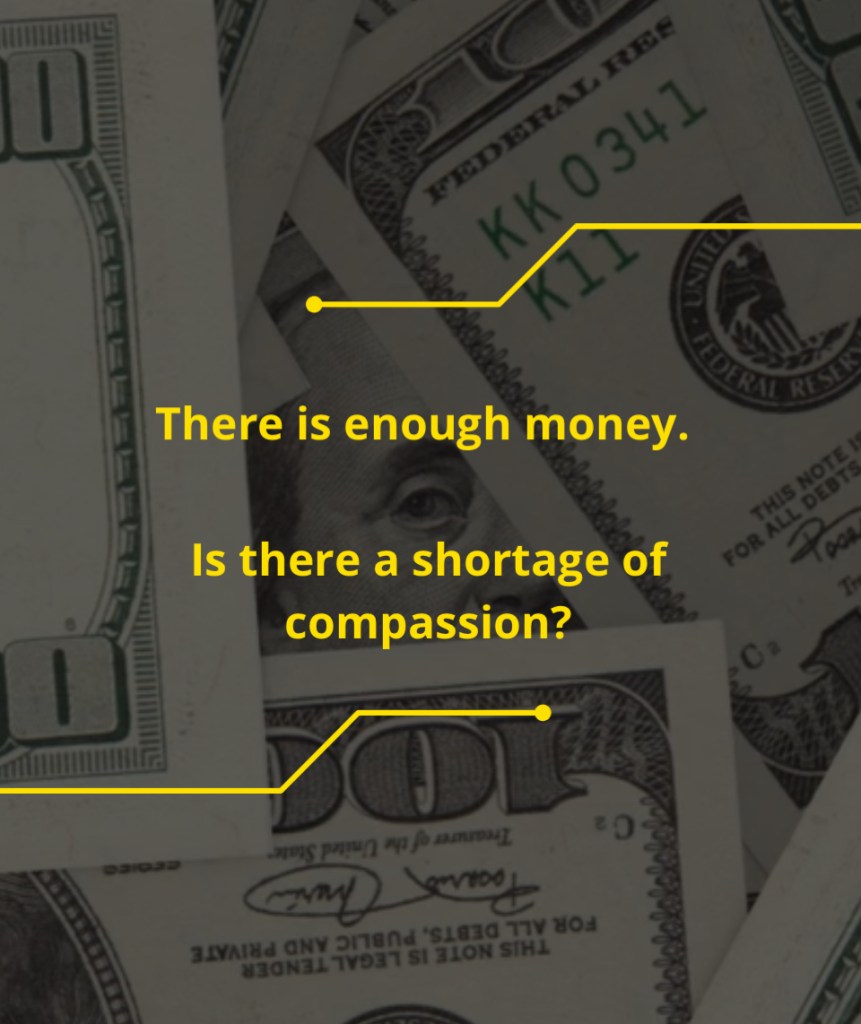
If there is one thing the world needs more of, it is servants.  There is enough money.  There is enough food.  There is enough stuff.  There are not enough servants.  

So next time you are tempted to say, “You know what they should do”, perhaps say, “Here am I Lord, send me.” (Isaiah 6.8)

Servant of ALL

“If you want to be great in My kingdom, be a servant of ALL.” -Jesus

This idea of being a servant of all is not designated for times when it is convenient, not just when those in need of service look like you, vote like you, speak the same language as you, and dress like you. ALL is a pretty wide net. All includes “every tribe, every tongue, every nation.”

When considering this concept, if we include a “but, what if they…” then we aren’t getting it. God’s commands do not include asterisks, exceptions, and exemptions just expectations. The expectation is not that we can say it, the expectation is that we would live it.  

Jesus spoke the following words, “If you love me, you will keep my commandments.”  He did not ask His followers how much you know rather He said, do what you do know.  At some point we have flipped the script.  We place a large amount of weight on knowledge and have seemed to relax a bit on the doing or have simply relegated the doing to being nice.  

Please do not think that I am diminishing the importance of knowledge.  I am not.  I live in pursuit of it every day of my life.  But at the end of the day, you and I will be remembered not by what we knew but by what we did with what we knew.  

I have a relative that at one point told me the entire plan of salvation.  Is that enough?  Nope. She flat out rejects it as truth.

I know people who believe the Scriptures when they say “all people are image bearers of God and therefore have value” but at the same time live very privileged lives and never consider that Jesus heart was positioned towards “the least of these.”  This is not a gap in knowledge.  This is a gap in obedience.  

The problem is that our faith is often big enough to embrace a truth while we attend Bible Studies but is not big enough to embrace while we are interacting with the marginalized.  In this Jesus says, “If you love me, you will keep My commands.”  Jesus does not just want your amen to be something that comes out of your mouth.  He desires that your amen would be something that flows from your life.  Our hearts should be bursting with the idea that I am convinced therefore, I do. 

In Romans 12.1 we read, “Therefore I urge you, brethren by the mercies of God, to present your bodies a living and holy sacrifice, acceptable to God, which is your spiritual service of worship.”  How does one present their bodies as a living holy sacrifice?  It is much more than putting on the mind of Christ.  It also includes the hands and feet.

Billionaires, World Hunger, and Coffee Thoughts

I recently read an article about the 15 richest people in the world.  My first thought? They could end world hunger.  Did a little research, as I am not the first to have that thought and found that a 2% annual donation from the world’s 3,000 billionaires could eliminate global hunger and malnutrition, according to various studies.

While I know that forced donations (taxes and tariffs or whatever you want to call them) aren’t a popular method it does show that we don’t live in a world that is lacking resources.  We live in a world where there is excessive hoarding of wealth.  All that is needed for humanity to flourish (at least on the physical side) already exists.  We don’t need more programs.  We need people who see their neighbors and who value of their neighbors.  This world does not have a shortage in resources, it has a shortage in compassion.

Furthermore, there are some very generous deep pockets out there, but generosity is often tied to what the giver wants rather than what those who are vulnerable need. The question ought not be what do I want but rather what are the real needs in my community.  We need to ask these questions as humans, as organizations, as churches, as governments, etc…

I guess what I am trying to say is this.  Love your neighbor.  See the vulnerable, not as people or situations to be fixed but as fellow people to be served.  Offer hope with the help.  Jesus did this all the time.  Not only did He pass out real bread, but He also said, I am the bread of life.  Not only did He heal the sick, but He is also I am the great physician.  

Whenever I share thoughts like this, I get lectured that it would never work because donations given would be taken by the powerful before they ever reached the vulnerable.  Those who claim this are correct, but this shouldn’t stop us from trying to eliminate hunger and alleviate hardship.  Our doing good should not be dependent on how those who do evil might respond.  We are responsible for us, not them.  And hypothetical wrongdoing does not release us from very real needs.

“So, whoever knows the right thing to do and fails to do it, for him it is sin.” -James 4.17

These are my morning coffee thoughts… 

A White Christian’s Reflection on Racism and Juneteenth

When I was 11, I was sitting in my neighbor’s kitchen sipping on a glass of sprite.  This was tradition after all.  When I finished up mowing my elderly neighbor’s lawn, she would pay me and then give me cookies and sprite.  Sometimes we sat and chatted for 45 minutes or more which caused my parents to jokingly call this older woman my girlfriend.  One day while enjoying our sprite and cookies, she told me about people who had recently looked at the home for sale next door.  She was quite worried too.  After all she did not want them moving next door to her.  She did not want black next-door neighbors.

When I was in my teens, I worked at a Christian camp and served under a man that I loved.  He was an amazing Bible teacher and had a deep love for people and deep love for sharing the gospel.  He was a gifted evangelist and used his gifts well.  When someone would do something out of line it was not uncommon for him to refer to them as a “cotton picker.”

When I was 21, I was doing an internship at a ministry that reached out to town kids.  In fact, it was right down the road from the local high school.  This town also was quite diverse for the area we were living in.  One day I was headed somewhere with the man I was doing my internship under.  A man who was also a pastor.  We passed a park bench in town where 3 teenagers were hanging out and he said, “I hate to see that.”  Naively I asked, “what teens hanging out on main street?”  He replied with, “No, a pretty white girl hanging out with black guys.” 

When I was 22, I was attending Bible college and working with their maintenance department.  One day me and another guy who worked for the college took a drive across town with a school van to pick up something from a storage unit.  The storage facility was in the midst of a residential community just off the highway.  As we were pulling into the facility the college employee said something I didn’t quite make out. I said, “What?” He nodded towards the porch where a black family was sitting enjoying the summer air and repeated himself and said, “I call them porch monkeys.”  He then laughed at this incredibly racist remark.

When I was 26, I took my very white youth group out of our very white town to a conference in the south.  I remember rolling up to a stop light.  My fellow youth worker said, “lock the doors.”  I said, “why?”  She then eyeballed the black man standing on the corner.

When I was in my 30’s, I learned for the first time what redlining was.  Growing up I remember there being a black part of town.  I did not understand that this was by design and represented a much larger systemic issue.

When I was in my 40’s, I learned what Juneteenth was.  Like many others I was unaware of the history behind it and had no clue that Texas still had slavery when the rest of the country had abolished it.  It wasn’t till Juneteenth was signed into law that this truth would come out.  Still, people would claim that this holiday was made up and that we already had an Independence Day.  

The sad truth is the items listed above took me 5 minutes to think about.  They came to me but stuck with me because I have always felt that these things were wrong when so many in my world have normalized them.  So many Christians have normalized these behaviors and thus projected diminishment rather than love.  

When I began to study redlining it dramatically changed my eyesight.  I began to understand at a much deeper level what the issues were within our society and began at times to call out those behaviors that once were deemed as normal.  I began to inwardly cringe when color became a defining factor rather than character.  When people say, “I met a very helpful guy yesterday, he was a black guy, and he gave directions to the pizza shop.”  How is the race of the helpful person helpful to the conversation?  I wouldn’t describe a white person this way.  I would simply say, “I had to ask for directions to the pizza shop.”  It’s almost as if the words “helpful” and “black” combined provide a shocking detail to the story like the good Samaritan story that Jesus told.

I have had a lifelong love of hip-hop, R&B, and gospel music.  I was drawn to it at a young age and even last night I was driving my truck blasting hip hop.  Not because I want to be cool (trust me, I am not) but because I simply love the music.  As a kid, my love of this  caused a pastor to call me out from the pulpit and my choice of music was often referred to as jungle jive.

I was a kid when I first heard about Equal Opportunity Employment.  I saw a construction zone and saw a lady holding a flag.  It was stated that she checked two boxes because she was both black and a woman.  There was no thought given to the fact that she was probably quite qualified for her job and might have been taking a break from operating equipment.  In fact, the opposite was true, it was insinuated that she was not qualified because she was a black woman in a construction zone.

As my eyes have opened, it has become quite apparent to me that racism has surrounded me my entire life. Now some will accuse me of wokeness for saying this.  I am at the point where I simply don’t care.  Seeing people’s struggles is a fruit of loving them and therefore that accusation is not an insult but rather an encouragement that I am doing it right. 

So why do I write this on Juneteenth?  I write this to say, that I wrote this entire article in 20 minutes.  Thinking of examples of what to write was incredibly easy.  If I put the time in, I could probably write thirty pages of things that I would classify as racist that were said or done by people that I know and most of them are people that would tell you that they are Christ followers.  This is a problem.

  • To my knowledge, nobody has ever hoped I wouldn’t buy the house next to them.  
  • To my knowledge, nobody complained that I hung out with girls when I was a teen.  
  • To my knowledge, nobody uttered racial slurs because I just wanted to spend time with my family on my front porch during the summer.  
  • To my knowledge, nobody ever locked their car door when I stood on a street corner.
  • To my knowledge, nobody denied my parents a mortgage because it was in the wrong part of town. 
  • To my knowledge, nobody questioned my credentials because of my skin color. 
  • To my knowledge, nobody denied my grandparents from the ability to vote.  
  • To my knowledge, nobody refused payment of the GI bill when my grandfather got home from WWII. 
  • To my knowledge, my mother did not have to use the side entrance to the movie theatre and then sit on the balcony.  
  • To my knowledge, my parents weren’t forced to walk to their underfunded school while the other kids’ road a bus to their school where resources abounded.  

Some would call this white privilege.

The question should not be, is this woke?  The question should be, is this truth?

So, this Juneteenth do me a favor.  I want to encourage all my white friends to sit down with a pad and paper.  Write out a list of things you have seen that dehumanizes our black brothers and sisters.  Then maybe when you are done, commit to do better.  Juneteenth is a reminder to all of us that we must do better.  

When we open our eyes to inequity, we quickly are overwhelmed by how many exist.  You can’t fix the world, but you can make those within your world experience more dignity and hope.  This is a responsibility that is on you and is on me.  So, this Juneteenth, speak up, stand up, listen better, and love better.

Get Curious

Allow me to begin with my thesis statement; curiosity is the fruit of maturity.

As I have grown in my faith and become more and more convinced of the truth found Matthew 22 it has caused me to become way more curious about people.  For those of you not familiar with Matthew 22, let me catch you up to speed.  

In Matthew 22 Jesus is asked a question, “Teacher, which commandment is the greatest.”  Jesus replies with, “Love the Lord your God with all your heart, soul, mind, and strength.”  He does not end here.  He goes on to say, “and the second is like it, love your neighbor as yourself.  All the law and the prophets hang on these two commands.”

Obviously, we know that we are to love God and to love others if we are Christians.  But let me ask the question, have we ever thought of the idea that loving your neighbor is like loving God?  Jesus says, the second command, the command to love one’s neighbor, is “like it”.  The “it”, being the first command of loving God.  He also would go on to say in Matthew 25 that what we do to others, we do to Him.  How we treat the poor, the imprisoned, the sick, etc, is felt by Christ Himself.  I didn’t say it.  Jesus did.  Loving others, is in fact, the fruit that is produced when our heart loves God properly.

As a Bible college and seminary student, I was taught to be a student of the Bible and to be a student of God.  In my churches growing up I was taught the same.  In the summer Christian summer camps I attended, I got the same message.  I was taught to be a student of the Bible and to love God and to love people.  Yet, something was oddly missing in my spiritual formation and for much of my formal training and in my time in church.  While I was taught to love others, I was also taught to fear them.  Avoid sin.  Avoid sinners.  Don’t drink, don’t dance, don’t chew, and don’t go with girls who do was actually said in a church I attended at a child.  

This mentality is at odds what we see of Jesus in the Scriptures.  For as many live their lives trying not to have sin rub off on them, Jesus lived in such a way that righteousness rubbed off Him and onto others.  

There seems to be an us versus them idea that has crept into much of the church world.  Amongst the churchy, you can hear it in the verbiage that is used to describe people who are not Christ followers.  Many Christians use “the world” as labels for those outside the church and use it in such a way that it’s more like a derogatory term of insult than anything else.  Sadly, far too many Christian communities do not resemble a lighthouse but rather a holy huddle hiding its light under a bushel basket, fearing the influence of the world and seemingly forgetting they are the ones who are to be doing the influencing.  

I would suggest that this is not a sign of spiritual maturity but rather a blatant showing of spiritual immaturity.  Safety is not the call that God has on the life of His followers.  In fact, He said, they hated me, don’t be surprised if they hate you too.  

Allow me to reiterate my thesis statement: curiosity is the fruit of maturity.  How does this tie into what I said above.  Well, if Jesus was serious about what He said in Matthew 22 and how we treat others is in fact felt by Christ, then our spiritual formation should not just include Theology Proper (the study of God and His attributes) but should also include anthropology.  While my use of anthropology might not be the proper sense of the word here, I think you understand what I mean.  We must be students of those we are called to love so that we can more effectively love them. 

The truth is this, because I love God, I seek to know Him.  Many Christians say they love their neighbors but do zero homework on how to love them better.  The first way to demonstrate one’s love is to get to know the object of the love so that you can love them more effectively.  Get to know their stories and get to know the whys behind what they do.  This is not hard, but it also isn’t popular.  Get curious.  Approaching one’s neighbor armed with trite statements like, “God said it, I believe it, that settles it” will never lead to life change.  Approaching others with a genuine love and curiosity is where true connection happens.  Much of the problem is that many church people have treated those who aren’t in the church as targets of a command (Think the Great Commission) rather than objects of their love.  People aren’t goals to be conquered they are valuable image bearers of God to be cherished. 

These ideas have led me down a path over the last several years that have caused others to call me woke, been the reason for verbal confrontations and social media ones, and even been reasons people have left my church.  Yet, I cannot stop.  My curiosity of others has caused me to research many topics that I lacked knowledge in.  My research sprung up from a deep seeded conviction that I could not love people well if I did not understand their stories.  Questions like, why has there been so much racial unrest in our country?  Why do men and women of color cry out “Black lives matter”?  Why are people trying to sneak over our borders?  What is redlining?  Why is quality healthcare more accessible for the wealthy?  Why is quality of education based on where you were born when my state has the “same standards” for all schools?  Why are women limited in many places with what they are allowed to do?  There are so many questions to be asked, and these questions should be asked.  After all, its hard to love people well when we don’t know their story.  Where did you come from?  Where do you desire to go?

Simply put, I cannot claim to love people if I am unwilling to my homework.

I am quite aware that there will be some who read this and struggle with the words that I write because of their deep seeded belief that people need Jesus and the message of the cross is where power exists to change lives.  I too believe that it is in the power of the cross that brings true change, but I also believe that we ignore both Christ’s example and many of His teachings if we limit our call to merely preaching the Gospel.  After all Jesus fed the hungry, Jesus healed the sick, Jesus elevated women, Jesus defended the downcast, Jesus shared meals with sinners, Jesus offered hope to criminals, Jesus instilled value into the lives of all He met, and so much more.  This list is not exhaustive, but it is a demonstration of the fruit of the Gospel.  I cannot claim to love someone and at the same time be content with their pain.  Jesus did all these things and died on the cross.  

While I recognize that food does not save a soul, I do believe it can be a step toward salvation. When you tell a starving person, “you need Jesus” do you know what they are thinking?  They are thinking, “no, I need a sandwich.”  Start where they are.  Love them there.  That’s what Jesus would do.  

In conclusion, get curious.  As the hard questions.  Sit at a table with a person who is living a life you disagree with and ask words of clarification.  Share a coffee with a person who votes differently than you and ask them to articulate their why.  And PLEASE, don’t use their answers as a means to judge them more effectively.  Use their answers as a means to love them better.